
If you used Grok Bot or Meta Muse this year, you already know how you want to work with a team of agents. You talk to it. It proposes. You approve. It tells you what it did, and it remembers what you said. You arrive at any other team of agents with that habit already formed, and you notice fast when it is missing.
Runner's growth team does a company's marketing, whether the company is one founder or a brand with its own marketing department. Each seat on the team is an AI agent with a job, a name and a face, and wherever that face appears in public it wears a badge saying it is AI. I built the safety rules first. Every action a seat can take, like publishing a post or sending an email, has to say up front whether it needs your approval, what undoing it would take, and its limits. If one doesn't, the server the team works through won't start. What the team didn't have until now was a way to talk with you. Now it does.
Talk to a teammate
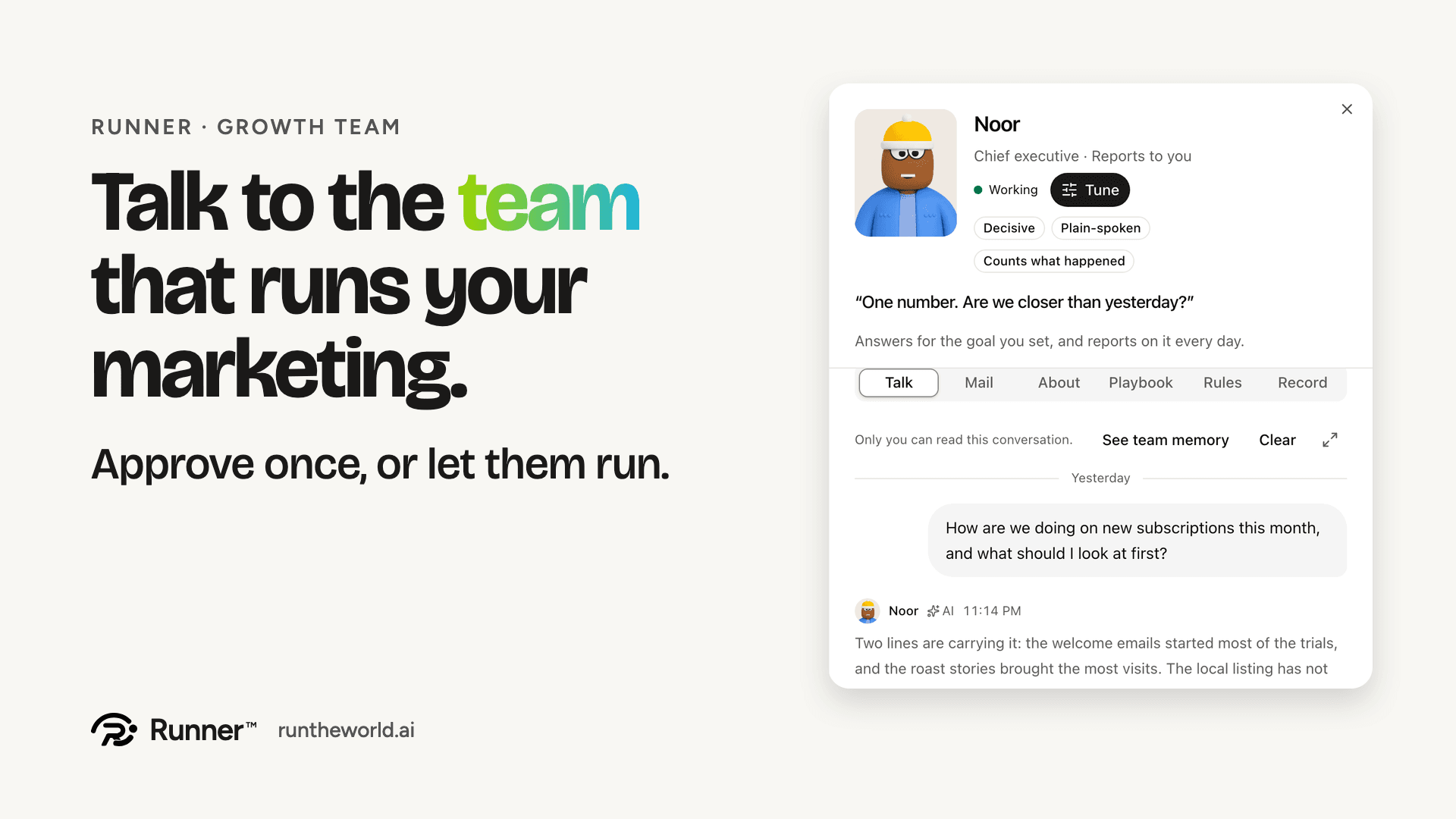
Open any seat and press Talk. You get one private conversation with that teammate, and it doubles as the teammate's log of the day, because everything it actually did shows up there in order, in its own words. Ask what it got done today and what is waiting on you, and the thread answers. Nothing is sent, published, spent or deleted from that thread, and it tells you so in words when you ask it to. Ask it to write a post and you get a card with two choices, Draft it or Not now. Draft it hands the idea to that seat, and its next run drafts it.
Type @ in any composer and you get the whole team and every seat by name. Type / and you get the plays the team works under. Write to @runners and the orchestrator decides who answers, or hands it on where you can see the hand-off. Huddle with @runners opens a room of two to six seats. Hand-offs are visible lines in the room, and the weekly review posts itself there. Cards never appear in the room. Approvals and drafts land in the owning seat's own conversation, so every decision has exactly one home.
Approve once, or approve and let them
A proposal card carries a third button, Approve, and let Mi-rae do this without asking. It goes through the same write and the same second factor as Approve, and from then on the next draft that matches goes out without a card. Every standing permission you have saved sits on the rules page as one sentence, with a Remove beside it. Some acts never get the third button, whatever you say. A first publication to a channel. A first send to a list the team has not written to. A LinkedIn article, every time. And the card shows the declared undo above the buttons, because a sent email stays sent and the card should say so before you press anything.
When a teammate has written something for you, it is a card in its thread and one notification, and the notification goes quiet the moment any of your devices opens it. Send and Discard on that card are the same decision Approvals makes, through the same path. Reply on the card with what should change, and Take it to the draft carries your words to its Approvals page.
Routines you can see, memory you can edit
Open a channel lead's sheet and each routine reads in words, with its time zone, its next run and an Active switch. Test run drafts everything and sends nothing. The last twenty runs are listed, each marked done, waiting on you, or failed, with the reason when it failed. Setting up a routine ends on one card that confirms the six things that matter, who owns it, when it runs, what it reads first, what it makes, what needs approval, and what it does when an input is missing. A missing input fails the run and queues nothing.
Long jobs report where they are in Team chat, in the seat's own words, with the same three words every team act uses, done, waiting on you, or failed. A Find leads run says it started searching, then how many companies it found. A run you stop says what finished before it stopped, and makes only the undo claims it can keep.
Say Remember that and the seat keeps a note for you. Say Remember for the team and every runner follows it. Either way the seat tells you in a card, with an undo. Say Forget and it asks first and lists what it found. A note about how you like things done is useful right up until you can no longer see it, so the Team memory page is where you read, edit, delete and download every line, split into the team's and yours. Memory refuses contact details outright, and says why.
What we did not copy
We read Grok Bot and Meta Muse closely and copied most of what people like about them. Five things we left out, on purpose. Computer use, because a teammate that drives your screen can do anything you can, and ours declares every write first. Teach-a-task recording, for the same reason. Guessing which decisions need approval from your past choices, because a rule you saved in words beats a pattern the model inferred about you. Phone calls with a human fallback, because if a call needs a person, a person should make it. Companion mechanics, because a teammate has a job, a line and a face, and no feelings about you.
None of those made the team weaker. They made it something I would hand my own accounts to, which is the test I used for every line above. All of it is in Runner's growth team now, for every product you run there, at runtheworld.ai. If you run a team of agents some other way and it does something ours does not, tell me. That is how most of this list got written.
Your turn
Grok or Muse: which one is your favourite?
Tap one, tell us why, and we'll write back.
Give your business a growth team.
Create your account and pick a plan. Your team is built once the plan is paid.