
Two AI agents for business work are in front of owners this autumn, and Runner gets asked about beside both. So here is the answer, in the words of the comparison pages on runtheworld.ai. Muse is Meta's AI agent for getting business work done in the tools you already use. Grok Bot gives you AI teammates you set up by message and hand work across apps and websites. Runner gives growth a team of its own, built from your code or your POS sales report. None of the three asks you to drop the others.
You run the business. Put a team on growth.
In one line each. Muse: Meta's personal AI agent. Muse for Small Business adds skills and connectors for running a business. Grok Bot: AI teammates with names, jobs and context that builds over time, working on a persistent cloud computer. Runner: An AI team built around your business. Channel leads draft the work; leadership keeps it tied to the goal you set.
The four questions an owner asks, answered for each:
- How do I start? Muse: Share a goal and connect your storefront, business accounts and other tools. Grok Bot: Create a Bot, describe its job and give it context and access to your tools. Runner: Describe your business and customers, then connect a model. Runner proposes the team. Your code or your point-of-sale sales report adds context.
- What work does it take on? Muse: Growth plans, campaign drafts and reviews of sales and expenses. Grok Bot: Bots you create can research, draft outreach and work together across apps. Runner: A scout finds leads, channel leads draft outreach, and leadership reviews progress against your goal.
- What stays in my hands? Muse: You approve before it publishes, sends or spends. Grok Bot: It comes back when a task needs your approval. Runner: The target, budget and limits. Switch on email sending inside those limits; exceptions come to you.
- How do I follow progress? Muse: An action history of completed and planned work. Grok Bot: Updates and drafts in the conversation. Runner: Recorded counts against the target you set, plus a weekly review.
When to keep Muse, and when to keep Grok Bot
If Muse does this well for you today, keep it. Nothing here asks you to move. Muse works with Shopify, QuickBooks, Canva and your Facebook and Instagram accounts. Keep it there, and give growth a team of its own.
The same holds the other way. If Grok Bot does this well for you today, keep it. Nothing here asks you to move. Use both if you like. Grok Bot takes on tasks you hand it across apps and websites. Runner gives growth a team of its own, working toward a goal you set.
What Runner adds
Beside either agent, five things, each one a fact about the product today:
- Built around your business. Start from your code or your POS sales report. Runner proposes a team to match what you sell.
- A team, one job each. A scout finds leads and channel leads draft outreach. Leadership holds the team to your goal; two advisors argue both sides.
- Your model, your key. Pick the model each member runs on, from Anthropic, OpenAI, Google or xAI. It runs on your own key.
- Limits you set. Every limit starts at zero. Anything outside them comes to you as an approval, with the reason.
- A goal you set. You pick what counts and the date. Runner counts only what was recorded, never what an agent says it did.
Using them together
Muse and Grok Bot answer on request, inside a chat. Runner runs the program: a team with one job each, limits you set, and a record of what went out. So the division of labour is simple. Your assistant asks; Runner keeps the ledger.
The door between them is MCP, the open protocol an assistant uses to read another product's records. Runner's guide puts its endpoint in one line: Read narrowly. Propose with evidence. Get a person's approval for every change. Give it a ladder, not a master key. On the first rung: Look up a small answer inside approved projects. On the second: Draft a change with the records behind it. Leave the customer's record untouched. On the third: Run a change only after a person approves that exact call. Irreversible, destructive or wide-reaching tools are never offered. Clients connect with OAuth and PKCE using SHA-256, with no API key to paste into a configuration file.
The guide ends with five questions under one line, Ask any MCP server for clear answers to these: are permissions checked on every request, does a proposal leave the customer's record untouched, does approval bind one exact call, does every change have an undo plan and limits, and can you stop at the size of the problem. Whether a given assistant can take a custom MCP server is its maker's to say, so this article claims nothing about Muse or Grok Bot on that point. What Runner says for itself is at runtheworld.ai/guides/what-an-ai-agent-can-safely-do-in-your-crm.
Which AI model does Runner run on?
The one you pick for each member, from Anthropic, OpenAI, Google or xAI. It runs on your own key, so your vendor agreement and your rate limits apply.
Running on Grok
Runner runs on the model you pick for each member, on your own key. As of 17 October that can be Grok. A product owner or admin adds an xAI key under Settings → AI providers, and the card says it plainly: There is no shared xAI key on this installation. Grok runs only on a key you connect. Grok then takes its place in the growth-team lineup beside the other models.
On data, the same card carries xAI's terms as read from its developer docs: xAI keeps API requests and responses for 30 days to check for misuse and does not train on them without your permission; where xAI offers it, a team admin can turn on Zero Data Retention to stop even that.
Questions owners ask
Should I use Muse or Runner?
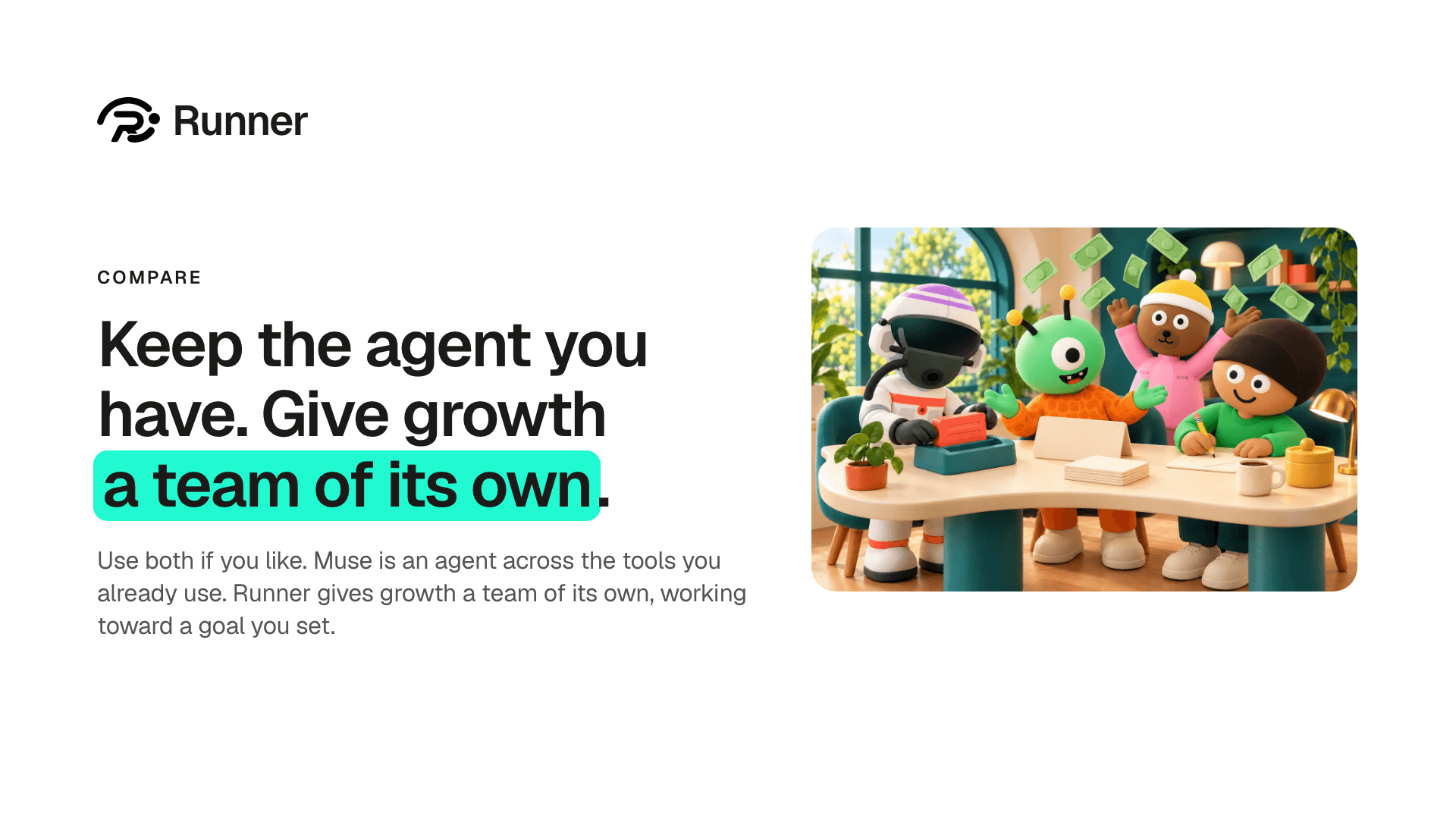
Use both if you like. Muse is an agent across the tools you already use. Runner gives growth a team of its own, working toward a goal you set.
Do I set up each agent myself?
No. Describe your business and connect a model, and Runner proposes the whole team. You review it before it starts.
Will anything go out without me?
Not until you switch the team on. Then it works inside the limits you set, and anything outside them comes to you first, with the reason.
Your business. Your goal. Your growth team.
Side by side, with every source: Muse vs Runner and Grok Bot vs Runner.
Build my team (opens in a new tab) beside the agent you already use, with a 14-day money-back guarantee.
What this article says about Muse and Grok Bot was read from their makers' pages: Meta's newsroom post (about.fb.com), muse.ai/business, security.muse.ai, docs.x.ai/grok-bot/overview and x.ai/bot/use-cases. Trademarks of their owners. No affiliation or endorsement.
Give your business a growth team.
Create your account and pick a plan. Your team is built once the plan is paid.