



The short version
- Newsjacking is answering news your buyers already care about, on your own site and channels, while the story is still fresh.
- Decide before the news breaks: write down when you respond and when you skip.
- A good response says what the news means for your customers, on a page you own, with a post for each channel pointing at it.
Newsjacking is answering the news your buyers are reading, while they are still reading it
Newsjacking is adding your own useful answer to a story that is already in the news: what it means for your customers, said plainly, on your own site and channels. The audience is already there, and the people in it are the people you sell to.
Read the detail
It is a growth play for any business whose buyers follow its market: a roaster when freight prices move, a software shop when a platform changes its rules, a clinic when a regulation lands. First to market wins. So does first to respond.
The short version: Be the business with a useful answer while the story is still being read.
The window is short, and it has been getting shorter
Attention on a story comes early. A study of trending topics in Nature Communications found that in 2013 an average hashtag stayed in Twitter's top 50 for 17.5 hours. By 2016 it was 11.9 hours.
Read the detail
Speed also decides who gets heard. Harvard Business Review's study of sales leads found that companies replying within an hour were more than 60 times as likely to qualify the lead as those that waited 24 hours or longer. News is a different setting, and the lesson carries: the first useful answer gets the hearing.
Decide what you respond to before the news breaks
Joining the wrong story costs more than missing one. So the deciding is done ahead of time, in a few rules written in your own words: when you respond, and when you skip.
Read the detail
Research on posts from 100 of the biggest advertisers, in the International Journal of Advertising, found that brand posts tied to timely events were shared more, and posts about unplanned events most of all. The unplanned ones are where a rule written in advance saves you from guessing in the moment.
- Freight costs for imported coffee go up.Respond. It changes what your customers pay.
- The delivery app your customers order through changes its fees.Respond. A platform your customers depend on changed.
- A film star opens a café across town.Skip. Your answer would only be about you.
- A rival raises a funding round.Skip. Funding news changes nothing your customers get.
- Respond when the news changes what your customers pay, do or worry about.
- Respond when a platform, a supplier or a rule your customers depend on changes.
- Skip tragedy and politics, and anything where your answer would only be about you.
- Skip funding and hiring news, unless it changes what your customers get.
A good response says what the news means for your customers
Lead with the consequence. A coffee roaster answering a freight surcharge says what it means for the price of a bag, and what the roaster is doing about it. One clear angle, in one sentence, before anything is drafted.
Read the detail
Then put it on a page you own: an article on your News page or blog, so your answer has an address people can link to. Cut the same angle into a short post for each channel you run, each one pointing back at the article.
The original announcement, not a summary of it.
Check it against your rules. If it's a skip, you're done.
What this means for your customers, and what you're doing about it.
The article first, on your own site. Then one short post per channel.
Then note how long it took, so the next one is faster.
Keep a person on the send
Speed is the point, and a fast mistake is still a mistake. Whoever speaks for the business reads the take before it goes out, changes any word, and drops a post or the whole thing when it isn't right.
The short version: The watching and the drafting are the parts to hand off. The judgment stays with you.
How Runner does it: First responders
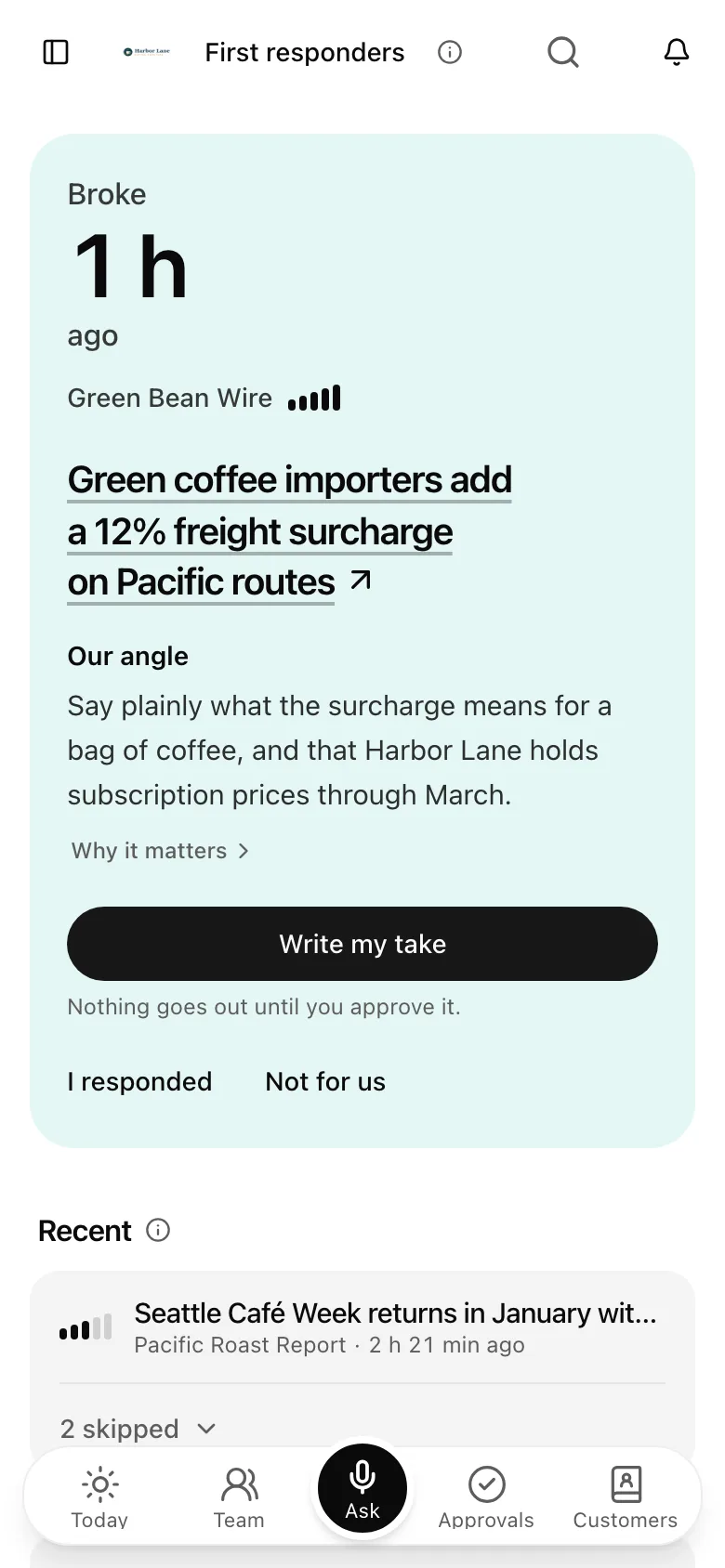
In Runner, you pick the news sources your buyers read and switch on the ones where being first counts. Your growth team checks each one every 10 minutes and reads every new story against your rules.
- Your phone buzzes when something your buyers care about lands.
- Write my take drafts your article and a post for each channel.
- Publish all with one press, and a clock shows how fast you were.
Read the detail
When something lands that your buyers care about, your phone buzzes with the headline. Press Write my take and your team drafts a hot take article for your News page and LinkedIn, plus a post for each channel it runs. Publish all with one press, and a clock shows how fast you responded.
Questions about newsjacking
What is newsjacking?
Answering a story that is already in the news with something useful of your own: what it means for your customers, on your own site and channels, while the story is still being read.
Is newsjacking risky for a small business?
It is when the story is the wrong one. Write your rules first: respond when the news changes something for your customers, and skip tragedy, politics and anything where the answer would only be about you. Keep a person on every send.
How fast do I need to be?
Early. Attention on a story is strongest in its first hours, and those hours have been getting shorter. A useful answer the same morning beats a polished one next week.
Do I need a blog or a News page?
It helps. A take on your own site gives people an address to link to, and gives your posts something to point at. A post with nowhere to point is gone when the feed moves on.
Can my team do the watching for me?
Yes. In Runner, First responders checks the news sources you choose every 10 minutes, pings your phone when something matters, and drafts your take when you press Write my take. Nothing goes out until you approve it.
Give your business a growth team.
Create your account and pick a plan. Your team is built once the plan is paid.